A 40ft tank container is designed for the safe transport and storage of liquids, chemicals, powders and other bulk products. Compared to standard ISO tank containers, a 40ft tank container offers additional volume or a specialised configuration for specific industrial applications. These containers are commonly used for international transport by road, rail and sea.
When transporting hazardous goods, a 40ft tank container must comply with strict ADR regulations. ADR is short for the French Accord européen relatif au transport international des marchandises dangereuses par route, which governs the international road transport of dangerous goods.
Because these containers are used for sensitive and sometimes hazardous products, they must meet strict requirements. This includes not only the design of the tank itself, but also inspection, maintenance, repair, testing and mandatory labelling to ensure safe operation throughout its lifecycle.
What is a tank container?
A tank container is designed to transport both hazardous and non-hazardous substances, such as chemicals, oils and food-grade liquids. The tank itself is usually made of stainless steel and protected by insulation and an outer cladding layer. The barrel is mounted inside a strong steel ISO frame, making it suitable for intermodal transport by road, rail and sea.
There are different types of tank containers, depending on the product and application. Examples include silo tanks for dry bulk products, reefer tanks for temperature-sensitive liquids and compartment tanks that can transport multiple products simultaneously.
The type of tank container is often classified by a T-code. In general, T-codes 1 to 3 are used for less hazardous cargoes, while higher T-codes indicate more demanding technical and safety requirements for hazardous substances.
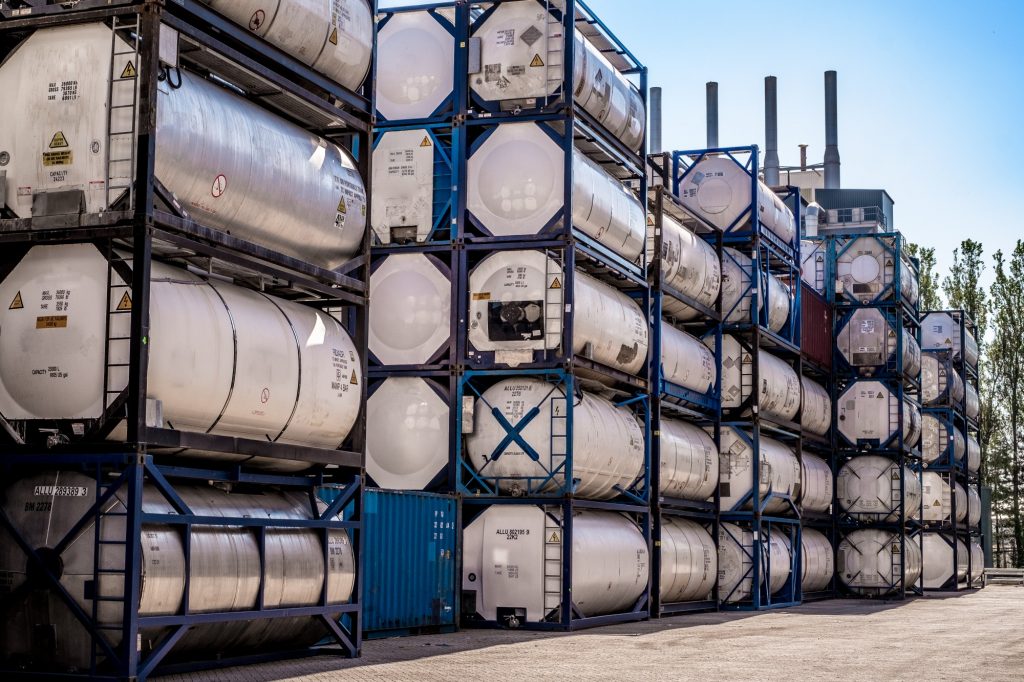
40 ft tank containers stacked and ready for delivery.
Dimensions and capacity of a 40ft tank container
Tank containers are commonly available in 10ft, 20ft and 40ft sizes. A 40ft tank container is primarily used when additional capacity or a specific technical configuration is required. Some models are also available as high cube containers, providing approximately 30 centimetres of extra height.
The exact capacity of a 40ft tank container depends on the design, insulation, wall thickness and intended application. Before selecting a tank container, operators should consider product density, pressure requirements, valve configuration, heating or cooling systems and the maximum permitted payload.
Indicative internal dimensions:
- Length: 11.590 metres
- Width: 2.294 metres
- Height: 2.557 metres
Indicative external dimensions:
- Length: 12.192 metres
- Width: 2.438 metres
- Height: 2.896 metres
These dimensions are indicative only. The exact measurements and usable tank capacity may vary depending on the tank design, insulation, fittings and intended use. For a broader overview of common container sizes, see our page on tank container dimensions.